
Enterprise-Grade Mining FMS: Weighbridge, Barrier & Real-Time Dispatch Explained
Published 14 May 2026 · 10 min read
“Enterprise-grade” FMS in mining means more than a bigger version of GPS tracking. It means a system that does not just observe the fleet but controls it, validates each trip, and recomputes its decisions every thirty seconds. This article explains what those systems actually do, where their gains come from in documented case studies, and the operational complexity they bring with them.
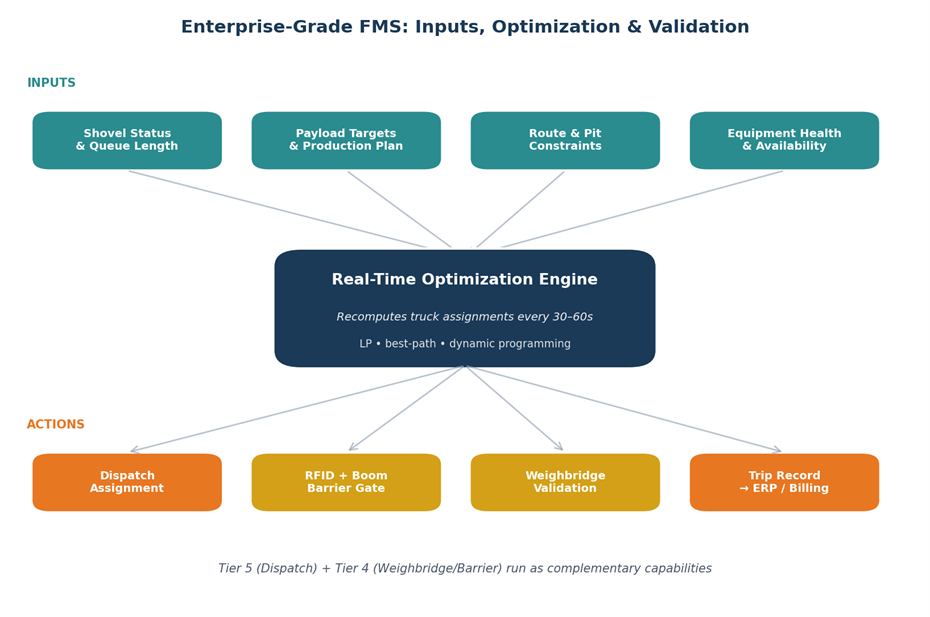
In the five-tier fleet management framework, enterprise-grade solutions sit at the top: Tier 4 (mining-grade FMS with weighbridge and barrier integration) and Tier 5 (FMS with real-time dispatch optimisation). Many of the world’s largest open-pit operations run both tiers as complementary capabilities, Tier 4 for trip validation and billing control, Tier 5 for production optimisation.
This is the tier where the FMS category started. Modular Mining’s DISPATCH, deployed from the 1980s at large open-pit copper and gold mines, was the original Tier-5 system. Modular Mining is now a Komatsu company, and Komatsu’s DISPATCH along with Wenco (a Hitachi company) are the two dominant Tier-5 platforms in the global and Indian markets. In the PSU context, SCCL has tendered for similar systems under the name OITDS, Operator Independent Truck Dispatch System, at its OC-I, OC-II, RG-III, OCP-III, RG-II and PK OCP projects[1].
What an Enterprise-Grade Mining FMS Actually Does
An enterprise-grade FMS combines two distinct capabilities that solve different problems:
- Trip validation and physical control (Tier 4): RFID tags on every vehicle, ANPR cameras at gates, boom barriers, weighbridges (gross/tare/net) and dump/crusher entry points. Each trip is automatically validated end-to-end: who drove, what was loaded, where it came from, where it went, what it weighed, how long it took and whether it followed the approved route, see our trip count and dump yard tracking use case for how this looks in practice.
- Real-time optimisation and dispatch (Tier 5): a central engine that automatically assigns trucks to shovels, dumps or crushers based on live shovel status, queue lengths, payload targets, destination availability and routing constraints. Assignments are recomputed continuously, typically every 30 to 60 seconds, using algorithms ranging from linear programming and best-path search to dynamic programming. Our excavator queue lengths use case shows one of the key signals dispatch acts on.
Documented Outcomes from Enterprise Deployments
Enterprise FMS exists because of the size of the production lever it can pull in the right environment. The publicly documented case studies worth pointing to are listed below, each with a clear mechanism and a verifiable source:
AGD’s Grib mine, Modular Mining DISPATCH, deployed 2015
Truck idle time at the crusher dropped from 210 hours per month to 38 hours per month after DISPATCH automated communication between the crusher operator and the central dispatcher and dynamically reassigned trucks whenever the crusher entered a Down state[2]. The earlier traffic-signal system at the same mine had not been able to solve the queuing problem in real time.
Komatsu DISPATCH, vendor across-installed-base claim
The DISPATCH product page states that customers using the system move 8% or more material each year by optimising equipment assignments, and save close to a million dollars annually on fuel by cutting unnecessary idle time[3]. These are vendor headline figures across the installed base, not a single-mine result, and should be read with that caveat.
Komatsu Performance Assurance at a South African coal mine
Before the Payload module was added to the mine’s existing DISPATCH FMS, trucks were being underloaded by an average of 13%. After integration, loading efficiency improved by 10%[4]. This is a documented Tier-4-style payload-validation case with a clear before-and-after methodology, see our buckets per truck use case for the same principle applied to loading.
Indonesia coal mine, Komatsu MineCare
Haul truck fuel consumption was reduced by 18% through a combination of MineCare monitoring and operator-behaviour changes identified through Performance Assurance engagement[5]. The digital fuel logging use case shows the field-level capture that feeds this kind of analysis.
Tata Steel Joda East Iron Mine, Wenco Mine FMS, deployed March 2024
Wenco’s FMS was rolled out across JEIM, with the announcement describing dynamic dispatch, real-time production management, optimised fuelling, real-time health monitoring and grade-control-aided blending[6]. Tata Steel did not put public numbers against any of these in the announcement, which is consistent with how most large Indian deployments are described publicly.
Tata Steel Noamundi, Wenco data driving training programmes
Noamundi has been running Wenco FMS for some years, and the FMS data was used to identify operator-behaviour variability around machine care, productivity and fuel efficiency. A targeted simulator-training programme by Immersive Technologies and Vareli Tecnac was built on top of that data[7].
The pattern across these is clear: public case studies that put hard numbers against gains tend to come from vendor publications, and they tend to be specific to one mine and one mechanism. When evaluating enterprise FMS, the most useful question is not “what is the typical improvement?” but “can the vendor point me to a named reference site whose operations head will take my call?”
Pros and Cons of an Enterprise-Grade Solution
| Pros, what enterprise-grade FMS delivers | Cons, operational realities to budget for |
|---|---|
|
|
When an Enterprise-Grade Deployment is Essential
Not every mine should buy an enterprise-grade FMS. The deployments that pay back fastest share a clear profile:
- Tier 5 dispatch is essential when the mine operates above approximately 10 MTPA with multi-shovel, multi-dump, multi-crusher operations, where queuing losses are material and the operational maturity exists to trust automated assignment decisions.
- Tier 4 weighbridge and barrier integration is essential when contractor trucks are a meaningful share of the fleet, billing disputes are routine, coal or iron-ore pilferage has been a concern, or the regulatory environment (Coal India, state PSUs) mandates RFID and boom-barrier-based gate controls. For contrast, our GPS / VTS pros and cons blog covers when Tier 2 alone is sufficient.
- Mines preparing for autonomy or major digital transformation. Caterpillar Command, Komatsu FrontRunner and EACON autonomous deployments all require Tier-5-grade dispatch optimisation at frequencies and accuracies that exceed conventional standards. Even mines not pursuing full autonomy benefit from the technology push that autonomy is forcing.
Common Pitfalls in Enterprise Deployments
- Buying Tier 5 dispatch when the underlying data discipline is not ready, then watching the optimiser make confidently wrong decisions. The first 90 days must focus on data quality before optimisation is enabled.
- Treating Tier 4 and Tier 5 as substitutes rather than complements. Dispatch is not an anti-theft system; weighbridge integration is not a productivity optimiser. Mature mines typically run both.
- Underestimating contractor change management. RFID and weighbridge integration directly threaten contractor billing margin where the prior system was lax. Expect organised resistance in the first quarter.
- Treating the FMS as an IT project rather than an operations project. Without a named operations leader reviewing dashboards daily and acting on exceptions, the system slides into being a passive reporting tool.
- Failing to budget for ongoing optimisation. The biggest gains tend to come in the second year, after data discipline has matured.
Where Enterprise FMS is Heading
The category is evolving in four directions worth tracking for any mine considering investment:
AI-driven exception management
Rather than presenting dashboards, next-generation systems flag the three or four specific decisions a supervisor needs to make in the next hour, and learn from whether those decisions were actually taken.
Convergence with autonomy
Autonomous haul truck deployments, Caterpillar Command, Komatsu FrontRunner, EACON, require dispatch optimisation at frequencies and accuracies that exceed conventional Tier 5 standards. Even mines not pursuing full autonomy are benefiting from the technology push that autonomy has created.
Edge computing and offline resilience
Pit connectivity will always be imperfect. Modern enterprise FMS architectures push more decision logic to the edge, onboard or to local site servers, so that a connectivity outage degrades performance gradually rather than catastrophically.
Integration with sustainability metrics
As Scope 1 and Scope 3 emissions reporting tightens, fuel-per-tonne data captured by enterprise FMS becomes an environmental compliance asset, not only a cost lever. Mines without this data will struggle to file credible reports for their parent companies’ disclosures.
Bottom Line
An enterprise-grade mining FMS is the most powerful fleet management technology available to opencast operators, and the most demanding to deploy. It delivers the largest documented gains in production, utilisation and cost discipline. It also requires the most mature operational organisation, the highest capital outlay and the longest implementation horizon.
The mines that get the largest returns from enterprise-grade investment are not the ones that buy the most expensive system. They are the ones that match the Tier 4 / Tier 5 mix to their own loss profile, resource the deployment with a named operations owner, and treat the first year as a discipline-building exercise before they expect the documented optimisation gains. Talk to our team if you want a structured way to scope a deployment, or explore MINEOPTIC Plus for the analytics layer that sits across Tier 3, 4 and 5 deployments.
Sources & References
- SCCL, Tender specification for GPS-based Operator Independent Truck Dispatch System (OITDS) at OC-I & OC-II, RG-III, OCP-III, RG-II and PK OCP. scclmines.com
- Komatsu case study, AGD’s Grib mine, DISPATCH FMS implementation (2015), truck idle time at the crusher reduced from 210 hours/month to 38 hours/month. komatsu.com
- Komatsu DISPATCH product page, vendor across-installed-base claims (8%+ more material moved annually; nearly $1M annual fuel saving). komatsu.com
- Komatsu case study, Active payload management at a South African coal mine (13% average underloading; 10% loading efficiency improvement after Payload module integration). komatsu.com
- Komatsu case study, Indonesia coal mine, haul truck fuel consumption reduced by 18% with MineCare and Performance Assurance. komatsu.com
- Tata Steel, Joda East Iron Mine Wenco Mine FMS implementation announcement (March 2024). orissadiary.com
- International Mining, Tata Steel’s Noamundi mine continuous improvement project supported by Immersive Technologies and Vareli Tecnac, using Wenco FMS data (May 2022). im-mining.com
Continue exploring
Typical Components and Outcomes of a Mining FMS
The four-layer architecture, eight capabilities to evaluate, and what real deployments deliver in practice.
Read blog →GPS-Based Fleet Tracking for Mines: Pros & Cons
The other end of the tier stack, what GPS/VTS does well, where it stops, and when GPS alone is the right answer.
Read blog →MINEOPTIC Plus
Multi-mine fleet & productivity intelligence with role-based dashboards for ops, maintenance and leadership.
Explore product →