Mineoptic Lite

Kill the paper. Keep the shift.

The fastest way to replace two of the most error-prone paper workflows in any mine — fuel logging and production counting.

Two focused modules work together to give you clean, reconciled, granular data without adding a step to your crew’s day.
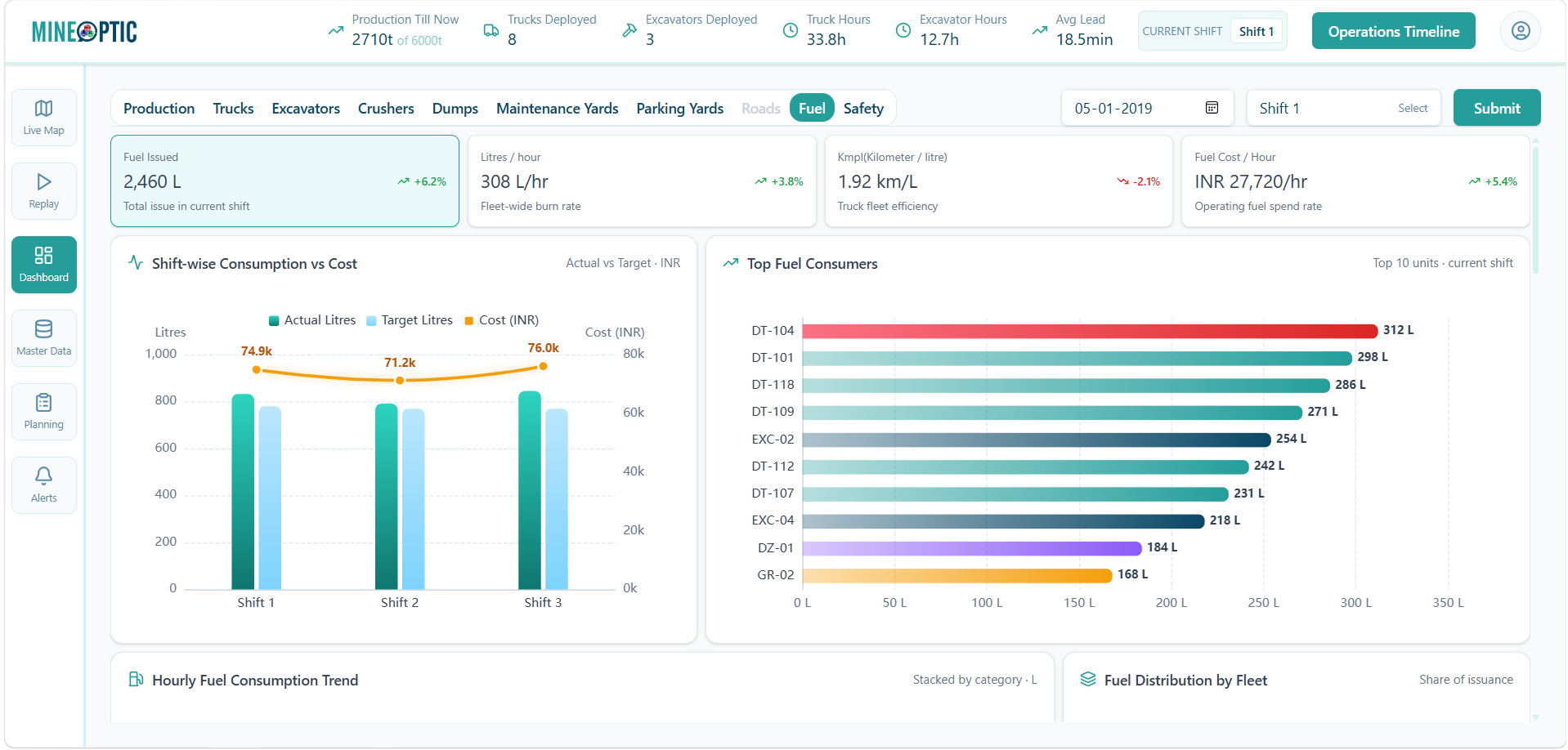
Mineoptic Lite dashboard

The problems Mineoptic Lite is built to solve

  • Fuel logging that drifts shift to shift because pens, paper, and dusty cabins do not play well together.
  • Truck counts that never reconcile because one card went missing between the gate and the dispatcher.
  • No visibility into bucket counts, load time, or how long a truck actually waits at the excavator or weighbridge.
  • Managers who cannot size the tipper fleet per excavator because the data has never been granular enough to decide.
  • Staff motivation falling off a cliff because the logging work is mundane and thankless.
Module 1 — Mineoptic Fuel

Tap. Snap. Synced.

Mineoptic Fuel puts fuel logging on a phone. At the bowser, the operator opens the app, photographs the truck number plate, the truck odometer, and the bowser meter — and that is it. The system reads, timestamps, geolocates and uploads the record automatically.

How it works

  • Operator opens the Mineoptic Fuel mobile app at the bowser.
  • Captures three images: truck number plate, truck odometer, bowser meter.
  • The app tags each image with the exact capture timestamp from the device, not a handwritten estimate.
  • If the bowser zone has no network, the record is queued locally and uploaded automatically when the device reconnects — both original and sync timestamps preserved.
  • Back-end recognition produces a clean fuel ledger — no manual re-entry, no manual mistakes, no lost cards.

Why it matters

  • Eliminates pen-and-paper error. No illegible handwriting, no wrong dates, no soiled cards.
  • Solves the connectivity problem. Offline-first capture means the crew does not wait for signal.
  • Keeps the time honest. Event time and upload time are both recorded.
  • Removes the mundane. Operators tap and move on.
Module 2 — Mineoptic Visual

Count every truck. Count every bucket.

Mineoptic Visual is the analytics engine that watches what your camera feeds have always seen but could never report. It counts trucks passing any route entry/exit of the dump yard, tracks how many times an excavator drops a bucket into a tipper to fill it, and measures time per bucket and per load — granular cycle data your spreadsheet always needed.

What it captures

  • Truck counts per route, per direction, per hour, reconciled against dispatch.
  • Bucket counts per truck, per excavator — the number that finally lets you size the fleet correctly.
  • Load time per bucket and total load time per truck.
  • Queue length and queue time at the excavator, weighbridge, crusher, loadout.
  • Trip breakup — travel, queue, load, unload — not just gross trip time.

Why it matters

  • Granularity the old way could not deliver. A camera with the right model will count what no one would.
  • Bottleneck data, not just movement data. Queue time at the weighbridge turns into a decision within a week.
  • Tipper fleet sizing, finally. Compute the right tipper count per excavator instead of guessing.
  • Hands-off operation. The crew does not log anything; the data comes from the camera stream.

Who Mineoptic Lite is for

  • Mines replacing paper registers and pen-logged fuel cards.
  • Operations teams who want real cycle granularity without a full FMS deployment.
  • Managers who need reliable numbers by mid-shift, not end-of-shift.

Ready to replace the clipboard?

See Mineoptic Lite running on a real shift.