
Typical Components and Outcomes of a Fleet Management System for Mines
Published 14 May 2026 · 9 min read
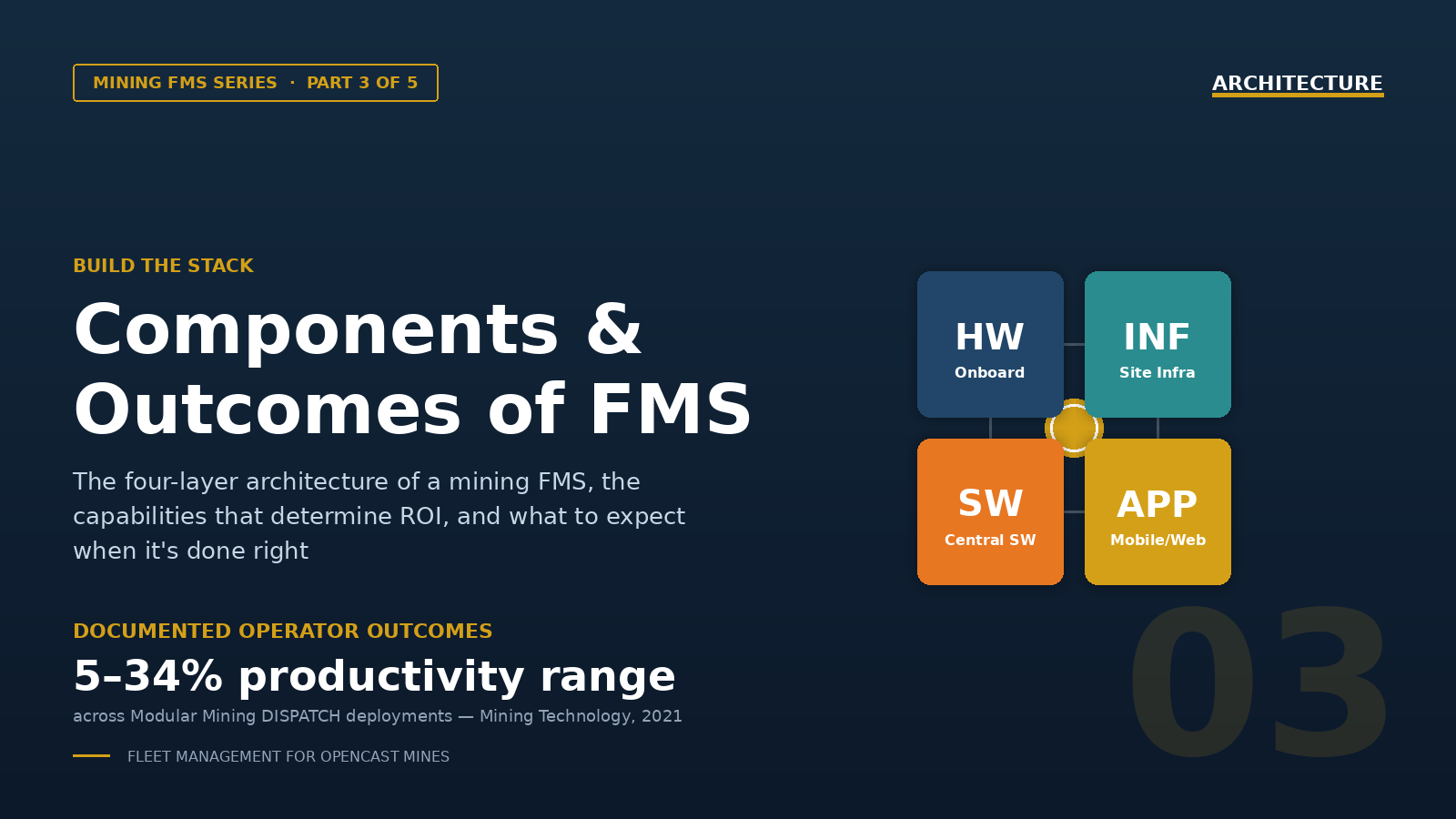
Once a mine has decided that a Fleet Management System is the right next investment, the question shifts from “do we need one?” to “what exactly are we buying, and what should it deliver?” An FMS is not a single product; it is a stack of components, capabilities and operational outcomes. The mines that get the best return are the ones that understand each layer before signing a purchase order.
This article describes the components a mining FMS is built from, the capabilities that determine its value, and the outcomes that a well-implemented system can be expected to deliver, with a clear note on which of those outcomes are documented in public case studies and which are practitioner judgment.
Core Components of a Mining FMS
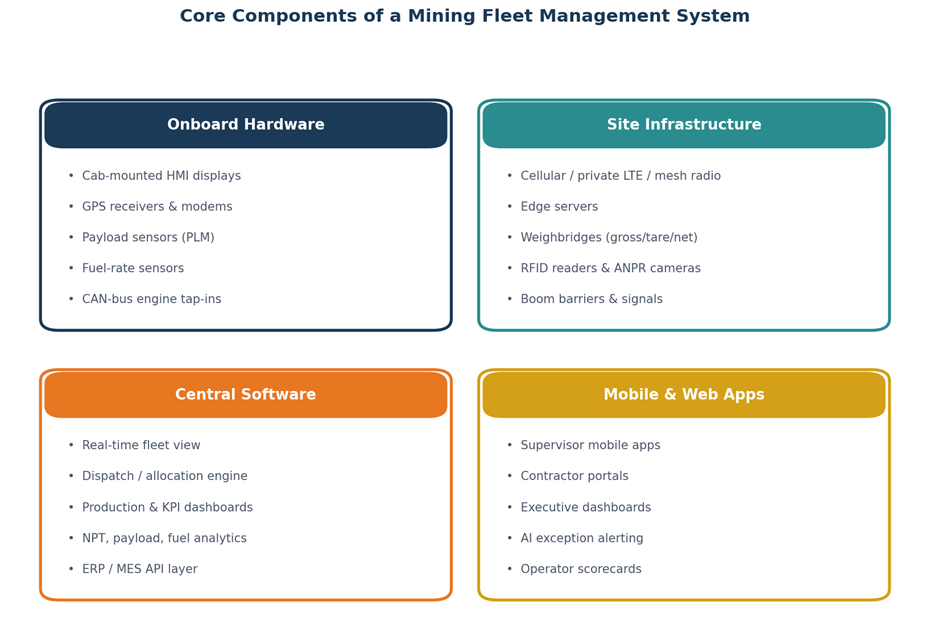
Regardless of the tier you deploy, the architecture is built from four layers:
Onboard hardware
Cab-mounted display units (HMIs) for operators, GPS receivers, cellular or mesh-radio modems, payload monitoring sensors, fuel-rate sensors and CAN-bus tap-ins for engine and equipment health data. Mining environments routinely subject hardware to dust, vibration, temperature extremes and frequent power cycling. Specifying IP65 or better, and asking vendors for mean-time-between-failure data from comparable deployments, is non-negotiable.
Site infrastructure
Communication backbone (cellular, private LTE, mesh radio or hybrid), edge servers, weighbridges, RFID readers, ANPR cameras, boom barriers and traffic signals. Coverage gaps inside deep pits can cripple a real-time system. Mesh radio supplements, repeaters and edge buffering are standard mitigations and should be specified in scope at the procurement stage, not discovered after go-live.
Central software
A real-time fleet view, allocation or dispatch engine (in Tier 5 systems), production reporting, KPI dashboards, NPT classification, payload analytics, fuel analytics, operator and equipment scorecards, maintenance integration and an API layer for ERP/MES integration. The single strongest predictor of FMS success in practice is whether the central software talks cleanly to the existing weighbridge software, ERP for billing and CMMS for maintenance. Integration paths should be verified during evaluation, not after purchase. This is the layer where MINEOPTIC Plus sits.
Mobile and web applications
Supervisor mobile apps, contractor portals, executive dashboards and increasingly, AI-driven exception alerting. The shift from “open a dashboard and look” to “the system tells you the three decisions you need to make in the next hour” is the most visible product trend in 2026, and it materially improves the rate at which insight becomes action.
Key Capabilities to Evaluate
When evaluating any mining FMS, these are the operational capabilities that actually determine the value delivered. Tier coverage varies, so map each capability against the loss profile of your mine before scoring vendors. (For a refresher on tiers, see our 5-tier framework.)
- Cycle time tracking, loading, hauling, dumping, returning and queuing, broken down by truck, shovel, route and operator. Available from Tier 3 onwards.
- Match factor analysis, real-time ratio of available trucks to shovel demand, with rebalancing recommendations. Advisory in Tier 3, automated in Tier 5.
- Payload management, target versus actual payload by truck, contractor and operator, with underload and overload alerting. Strongest in Tier 4, where it is weighbridge-validated rather than only sensor-estimated.
- NPT classification, automated capture and categorisation of stoppage events with delay codes. Available from Tier 3 onwards and arguably the single highest-value analytical capability in a mining FMS.
- Fuel management, litres per hour, per kilometre, per trip and per net tonne, with idling and queuing breakouts.
- Operator scorecards, productivity, payload compliance, idle time and harsh-event behaviour, used both for coaching and safety.
- Trip validation, end-to-end verification of source, destination, payload, route and operator. The defining capability of Tier 4 and the strongest control against billing leakage.
- Real-time dispatch, automated truck assignment. The defining capability of Tier 5. See also our excavator queue lengths use case for what dispatch acts on.
What Outcomes Look Like in Practice
The honest answer is that documented case studies in the public domain are limited. The numbers vendors share at conferences and in brochures should be treated as marketing claims unless backed by a named site and a clear methodology. A handful of outcomes are well-documented and worth using as anchors:
AGD’s Grib mine (DISPATCH FMS, 2015)
Truck idle time at the crusher dropped from 210 hours per month to 38 hours per month after DISPATCH automated truck reassignment whenever the crusher entered a Down state[1]. This is a single-deployment number from a published Komatsu case study, with a clearly stated mechanism.
Komatsu DISPATCH across-installed-base claim
The DISPATCH product page states that customer mines using it move 8% or more material each year by optimising equipment assignments[2], a vendor headline figure, not a per-mine result.
South African coal mine, payload module integration
Before Komatsu’s Payload module was added to the mine’s existing DISPATCH FMS, trucks were being underloaded by an average of 13%. After integration, loading efficiency improved by 10%[5]. This is a Tier-4-style payload-validation case study with a clear before-and-after methodology.
Tata Steel Joda East Iron Mine, Wenco Mine FMS, March 2024
Wenco’s FMS was rolled out at JEIM with the announcement describing real-time production management, dynamic equipment allocation, optimised fuelling, grade control and real-time health monitoring[3]. Tata Steel did not put public numbers against any of these gains in the announcement.
Tata Steel Noamundi, Wenco data driving training programmes
Noamundi has been running Wenco FMS for some years, and the FMS data was used to identify operator-behaviour variability around machine care, productivity and fuel efficiency. A targeted simulator-training programme run by Immersive Technologies and Vareli Tecnac was built on top of that data[4]. The case study describes the methodology in detail, although the specific productivity numbers are not in the public summary.
The practical implication: when evaluating vendor claims, ask for a named reference site that you can call. Aggregate “case study averages” in a brochure are not a substitute for a conversation with an operations head who has actually deployed the system.
Implementation Considerations That Decide the Outcome
The technology is rarely the failure point in a mining FMS deployment. The failure points are organisational, and there are five recurring ones:
Data quality and discipline
A dispatch system fed by inaccurate geofences, mis-coded delay categories or operators who do not log in correctly will produce confidently wrong recommendations. The first 90 days of any deployment should focus on data-quality discipline before optimisation is enabled.
Change management with operators and contractors
Operators view onboard systems with scepticism; they read it as surveillance rather than assistance. Visible operator benefits, smoother shifts, fewer arguments with supervisors, cleaner scorecards that protect good performers, need to be made tangible early. Contractors, in particular, often see RFID and weighbridge integration as a threat to billing margin and resist it actively in the first quarter.
Integration with weighbridge, ERP and maintenance systems
An FMS that does not talk to existing weighbridge software, ERP for billing or CMMS for maintenance will end up duplicating data entry, and within months the duplicate workflow gets dropped. Integration paths should be tested during evaluation.
Connectivity in the pit
Coverage gaps inside deep pits can cripple a real-time system. Mesh radio supplements, repeaters and edge buffering are standard mitigations and need to be in scope from day one.
Operational ownership
A successful FMS deployment needs a named operations owner, not only an IT owner. Without an operations leader who reviews dashboards daily and acts on exceptions, the system degrades into a passive reporting tool. This is the single biggest determinant of whether the deployment pays back in the first two years or stretches well beyond three.
Common Pitfalls
- Buying Tier 5 dispatch when the underlying data discipline is not ready, and watching the optimiser make confidently wrong decisions.
- Buying Tier 2 GPS and expecting Tier 3 productivity outcomes.
- Underestimating the change-management effort with contractors, who often see RFID and weighbridge integration as a threat to billing margin.
- Treating the FMS as an IT project rather than an operations project.
- Failing to budget for ongoing optimisation. The first six months capture the obvious gains; the next eighteen months capture the bigger ones.
Closing Thought
Components and capabilities are the straightforward part of FMS procurement. Vendors will happily walk anyone through their feature matrix. The harder and more valuable work is matching those components to the operational losses that actually exist on your site, and resourcing the deployment with an owner who treats the system as a discipline-building tool rather than a dashboard. Mines that do this consistently see returns that justify the investment. Mines that do not, end up with an expensive reporting tool and a depreciating asset. Talk to our team if you want a structured way to think through a deployment plan for your operation.
Sources & References
- Komatsu case study, AGD’s Grib mine, DISPATCH FMS (2015), truck idle time at the crusher reduced from 210 hours/month to 38 hours/month. komatsu.com
- Komatsu DISPATCH product page, vendor across-installed-base claims. komatsu.com
- Tata Steel, Joda East Iron Mine Wenco Mine FMS implementation announcement (March 2024). orissadiary.com
- International Mining, Tata Steel’s Noamundi mine continuous improvement project supported by Immersive Technologies and Vareli Tecnac, using Wenco FMS data (May 2022). im-mining.com
- Komatsu case study, Active payload management at a South African coal mine (13% average underloading; 10% loading efficiency improvement after Payload module integration). komatsu.com
Continue exploring
Why a Fleet Management System is the Need of the Hour for Opencast Mines
Where the operational losses live, what an FMS actually fixes, and the case for moving on it this financial year.
Read blog →Fleet Visibility Solutions Deployed in Indian Opencast Mines
The 5-tier framework actually deployed across Indian opencast mines, from manual controls to full OITDS-style dispatch.
Read blog →MINEOPTIC Plus
Multi-mine fleet & productivity intelligence with role-based dashboards for ops, maintenance and leadership.
Explore product →