
Fleet Visibility Solutions Deployed in Indian Opencast Mines: A Tier-by-Tier Overview
Published 14 May 2026 · 8 min read
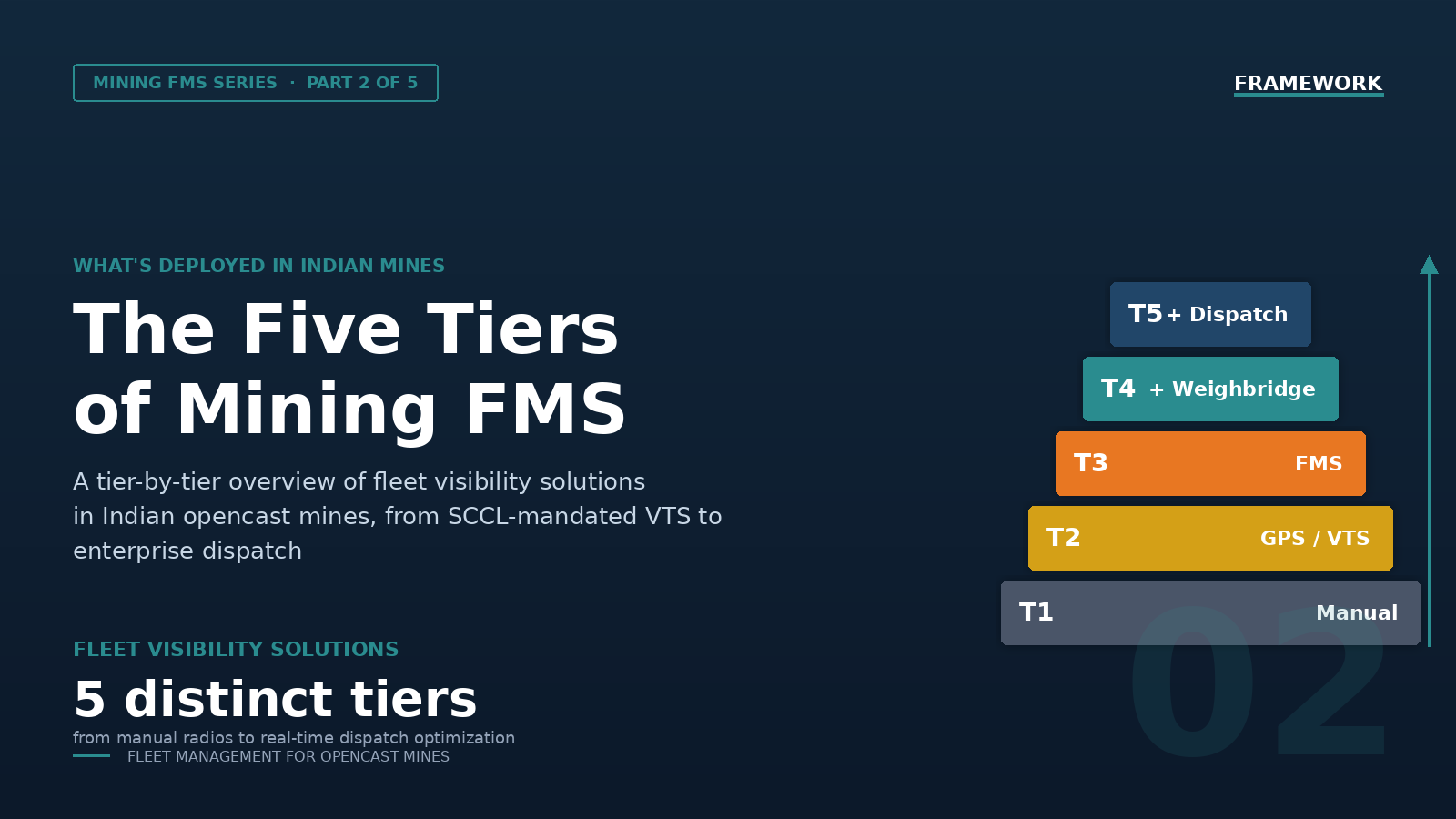
Walk into the control room of an Indian opencast mine and you will see one of five very different levels of fleet visibility. At one end, a whiteboard, a radio set and a supervisor who has done thirty years of pre-shift musters. At the other, a real-time optimisation engine that recomputes truck assignments every thirty seconds. Both are called “fleet management” by the people selling them. They are not the same thing.
This article lays out the five tiers of fleet management technology that are actually deployed across Indian opencast mines today, what each tier delivers, and where each one tends to be found.
The Five-Tier Framework
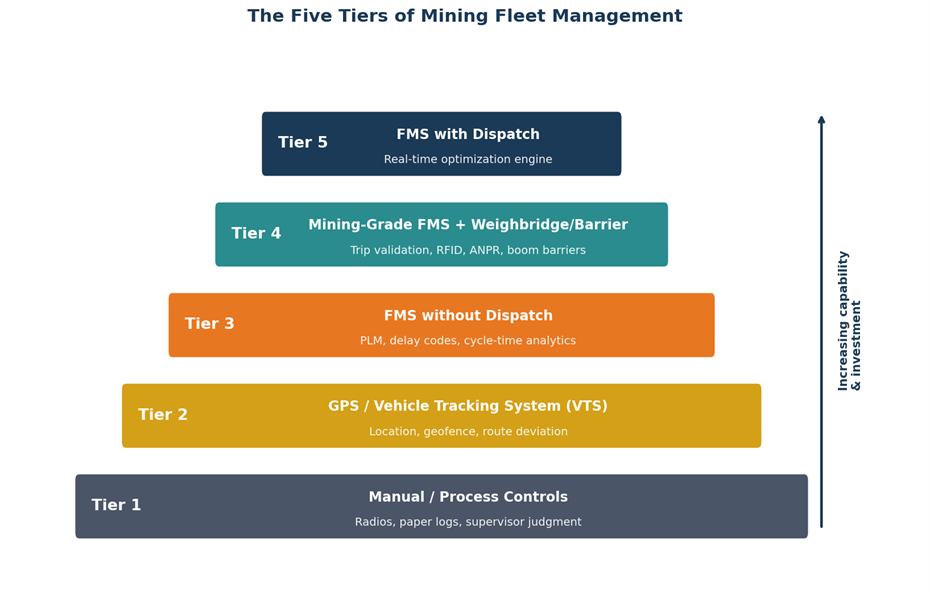
Each tier builds on the previous one and is defined by the type of decision it enables, not by branding. The framework is most useful as a buyer’s tool: matching the tier to the actual loss profile of the mine in question.
Tier 1: Manual / Process Controls
No technology layer beyond radios, paper logs and supervisor judgment. Allocation happens at pre-shift muster, queues are managed by hand signals and verbal radio coordination, and delays are reconciled on the control-room whiteboard at the end of the shift.
Small Indian quarries and single-shovel operations run on this tier, and run it well, when supervision is disciplined. The structural limit is data: every conclusion goes through a supervisor’s memory, every contractor dispute is a he-said-she-said, and there is no objective way to compare one month to the next.
Where you’ll see it: small aggregate operations, single-shovel mines and quarries.
Tier 2: GPS / Vehicle Tracking System (VTS)
Each vehicle carries a GPS device transmitting location, speed and basic event data, ignition on/off, geofence entry/exit, harsh braking, overspeed, to a central server. This is the single most widely deployed tier in Indian PSU mining today, almost always procurement-mandated. SCCL has issued multiple recent VTS tenders, the Naini Coal Mine tender of mid-2025 being one of the clearest examples; its stated purpose is monitoring coal transportation trucks to prevent en-route pilferage[1].
GPS/VTS delivers fleet-wide visibility. The dispatcher can see every truck on a map, check route compliance, detect unauthorised stoppages and review trip history. For anti-pilferage and contractor accountability, it works. What it does not do is measure what the truck is carrying, how productive the shovel was or why a truck stopped. It is a passive observer of the fleet, not a control system over it.
Where you’ll see it: most Coal India subsidiary mines, SCCL coal transportation operations and a large share of contractor-heavy iron ore operations in Odisha and Karnataka.
Tier 3: FMS without Dispatch
A full mining production-control system minus the optimisation engine. Onboard equipment computers, payload monitoring integration, delay-code capture, operator login/logout, cycle-time tracking, fuel telemetry, equipment health and fault codes, but trucks are still allocated by a human dispatcher. The dispatcher now has live cycle-time, queue and equipment-status data on a screen, instead of relying on the radio.
This is the tier where the data infrastructure for genuine productivity improvement gets built. Match-factor reports identify under- or over-trucked circuits. Operator scorecards highlight payload and cycle outliers. NPT is automatically classified by delay code. The advisory layer is solid; the limitation is that without automated assignment, the system advises but does not act. At 2:47 PM when a crusher chokes, a dispatcher still has to manually reroute trucks, and the speed and discipline required for this is hard to sustain across all shifts.
Where you’ll see it: multi-shovel coal and iron-ore mines that have invested in onboard payload monitoring and analytics, often supplied by Indian integrators working with global OEMs.
Tier 4: Mining-Grade FMS with Weighbridge and Barrier Integration
A Tier-3 FMS plus integration with the physical site control infrastructure: RFID tags on every vehicle, ANPR cameras at gates, boom barriers, weighbridges (gross/tare/net) and dump/crusher entry points. Each trip is automatically validated end-to-end: who drove, what was loaded, where it came from, where it went, what it weighed, how long it took and whether it followed the approved route.
This is the strongest single technology lever for trip validation, payload compliance, billing accuracy and anti-pilferage in contractor-heavy operations. Unweighed or invalid trips get blocked at the barrier itself. Detention timestamps are captured automatically. Finance teams get a defensible reconciliation between contractor invoices and verified trips, see our trip count and dump yard tracking use case for how this looks in practice.
Where you’ll see it: increasingly mandated in Coal India tender specifications and deployed at most large-tender coal and iron-ore operations where contractor trucks are a meaningful share of the fleet.
Tier 5: FMS with Dispatch (Real-Time Optimisation)
The full Tier-3 stack plus a real-time optimisation engine that automatically assigns trucks to shovels, dumps or crushers based on live shovel status, queue lengths, payload targets, destination availability and routing constraints. Assignments are recomputed continuously, typically every 30 to 60 seconds, using algorithms ranging from linear programming and best-path search to dynamic programming.
In the Indian PSU context, SCCL has tendered for exactly this kind of system, GPS-based Operator Independent Truck Dispatch Systems (OITDS), at its OC-I, OC-II, RG-III, OCP-III, RG-II and PK OCP projects[2]. The specification covers dynamic dumper-shovel allocation, hour-meter capture, equipment idleness alerts and exception notifications. On the merchant-mining side, Tata Steel’s Joda East Iron Mine deployed Wenco’s Mine FMS in March 2024[3], and Noamundi has been running Wenco for some years, with the FMS data being used to drive operator-behaviour training programmes[4].
The largest documented production gains in mining technology sit at this tier. The widely cited Komatsu case study at AGD’s Grib mine recorded a drop in truck idle time at the crusher from 210 hours per month to 38 hours per month after DISPATCH was implemented[5]. Komatsu’s own DISPATCH product page claims that customers using the system move 8% or more material each year by optimising equipment assignments[6], a vendor across-installed-base figure, not a single-mine result. Excavator queue lengths are one of the key signals such systems act on.
Where you’ll see it: a small but growing set of large operations, primarily in iron ore and PSU coal, where dispatch is being tendered alongside RFID and weighbridge controls.
How to Read the Indian Landscape
Two patterns stand out:
- The market is consolidating around Tier 2 and Tier 4. Tier 2 is procurement-mandated and becoming a commodity. Tier 4, RFID plus weighbridge plus boom barrier integration, is the fastest-growing investment area because it directly addresses the contractor-billing and pilferage problems that most Indian mines actually have. Tier 5 dispatch remains concentrated at very large multi-shovel operations.
- Tiers are not strictly hierarchical for every mine. A mid-sized contractor-heavy coal mine often gets more value from Tier 4 (billing and pilferage control) than from Tier 5 (dispatch). The right question is not “which tier is best?” but “which losses are largest in my operation, and which tier addresses them?”
A Simplified Decision Framework
- Mine under 2 MTPA, single-shovel, owned fleet → Tier 1 or Tier 2 is usually sufficient.
- Mine 2–10 MTPA, mixed owned/contractor fleet, billing disputes routine → Tier 4 is the highest-priority investment, with Tier 3 features layered on.
- Mine over 10 MTPA, multi-shovel, multi-dump, queuing is a material loss → Tier 5 delivers the largest production gains, often deployed alongside Tier 4.
- Mine preparing for autonomy or large-scale digital transformation → Tier 5 with a clear roadmap toward higher-frequency telemetry and AI-driven optimisation.
The honest reading: most Indian opencast mines are at Tier 2 today and need to get to Tier 4. That single hop, adding RFID, weighbridge integration and barrier-based trip validation, captures the largest immediate return for the typical contractor-heavy operation. Talk to our team if you want a structured way to assess where your operation sits today, or explore MINEOPTIC Plus for multi-mine analytics designed for Tier 3 and Tier 4 deployments.
Sources & References
- SCCL Tender ENN25O0016, GPS/GPRS-based VTS for monitoring coal transportation trucks to prevent en-route pilferage at Naini Coal Mine, Angul, Odisha (mid-2025). tendershark.com
- SCCL, Tender specification for GPS-based Operator Independent Truck Dispatch System (OITDS) at OC-I & OC-II, RG-III, OCP-III, RG-II and PK OCP. scclmines.com
- Tata Steel, Joda East Iron Mine Wenco Mine FMS implementation announcement (March 2024). orissadiary.com
- International Mining, Tata Steel’s Noamundi mine continuous improvement project using Wenco FMS data (May 2022). im-mining.com
- Komatsu case study, AGD’s Grib mine, DISPATCH FMS implementation (2015), truck idle time at the crusher reduced from 210 hours/month to 38 hours/month. komatsu.com
- Komatsu DISPATCH product page, vendor across-installed-base claim (8%+ more material moved annually). komatsu.com
Continue exploring
Why a Fleet Management System is the Need of the Hour for Opencast Mines
Where the operational losses live, what an FMS actually fixes, and the case for moving on it this financial year.
Read blog →Trip Count & Dump Yard Tracking
Track every truck trip and dump yard movement in real time. Close billing leakage and improve shift productivity.
Read use case →MINEOPTIC Plus
Multi-mine fleet & productivity intelligence with role-based dashboards for ops, maintenance and leadership.
Explore product →