
Why a Fleet Management System is the Need of the Hour for Opencast Mines
Published 14 May 2026 · 8 min read
An opencast mine is, in the end, a logistics operation. Haul trucks, shovels, dozers, graders, water tankers and service vehicles are continuously moving between pits, ramps, dumps and crushers, and every minute of misalignment between them costs fuel, working hours and tonnage. That is the operational reality a Fleet Management System has been built to address.
The case for installing one is no longer about whether the technology works. The case is about whether your mine can afford to keep operating without it. Cost-per-tonne benchmarks have tightened, contractor billing is under sharper finance scrutiny, regulators are mandating gate-level vehicle controls, and Scope 1 emissions reporting now demands fuel-per-tonne data that manual operations simply cannot produce. Each of these pressures, on its own, would justify a serious look at FMS. Together, they have made it a question the operations head, the CFO and the project chief now need to answer in the same financial year.
What an FMS Actually Does
A Fleet Management System brings together onboard hardware, communication infrastructure and central software to capture what the mobile fleet is doing in real time. Trucks, shovels, loaders, drills, dozers and graders feed continuous data on location, payload, fuel rate, cycle stage and equipment health into a single operational view. In its simplest form, an FMS keeps four questions answered continuously:
- Where is every piece of equipment at this moment?
- What is each piece of equipment doing, productive work, queuing, idling, breakdown, fueling?
- How does that compare to the shift plan?
- What should change in the next minute, hour or shift to maximise output?
Without an FMS, these questions are answered through radio chatter, supervisor memory and an end-of-shift reconciliation on the control-room whiteboard. That is precisely the gap where operational losses accumulate.
Where the Losses Live in an Unmanaged Fleet
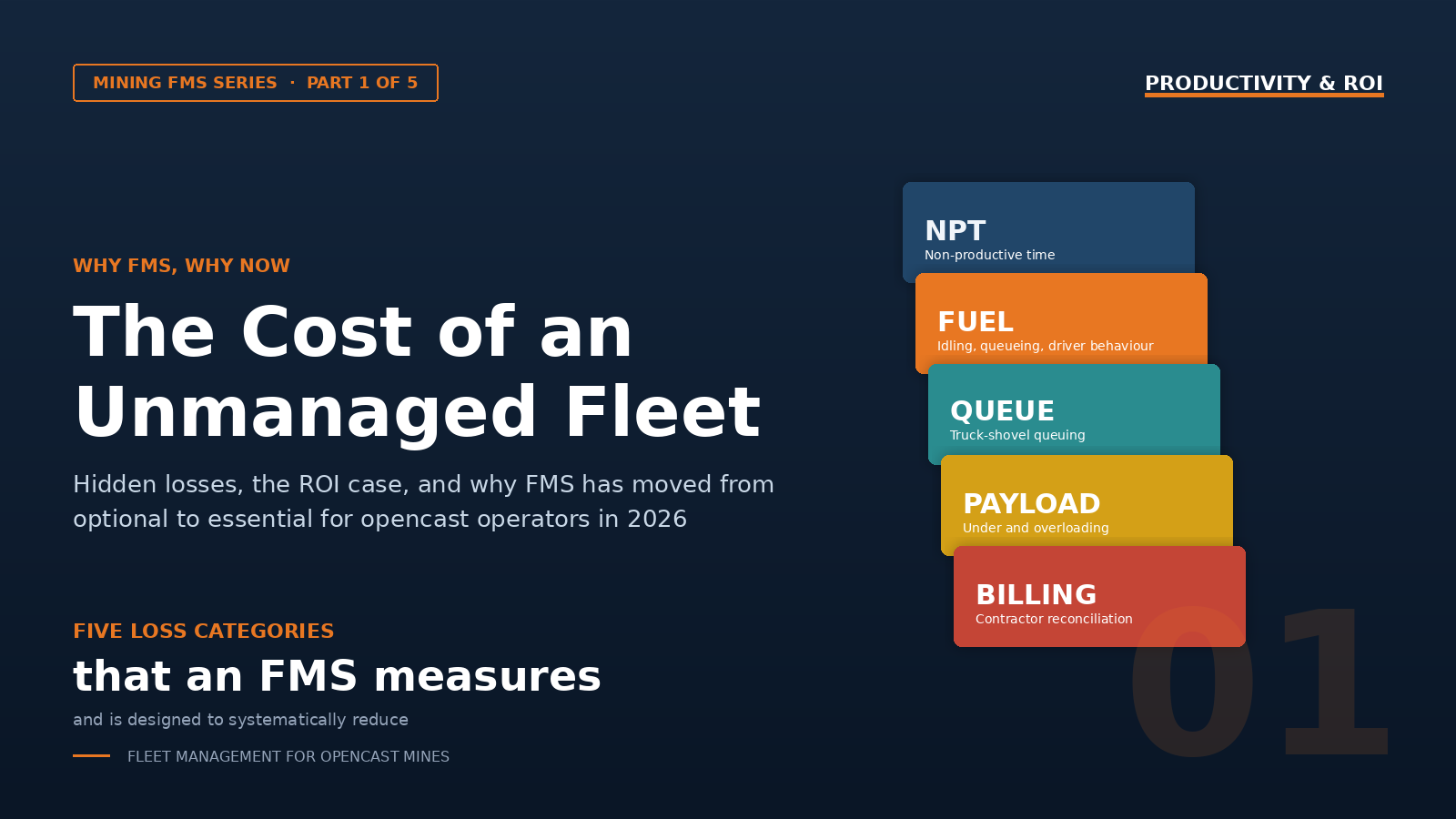
Five categories of loss show up consistently across opencast operations running on manual or partial-GPS controls. The original ranges differ from mine to mine, and the credible numbers in the public domain are limited; what follows is a description of where the losses live, with documented vendor case studies referenced where they exist.
Truck-shovel queuing
Trucks waiting at shovels, or shovels waiting for trucks. Every idle minute on a 200-tonne-class shovel is direct lost production, and every minute a truck queues is fuel burned for no output. The Komatsu case study at AGD’s Grib mine, where truck idle time at the crusher dropped from 210 hours per month to 38 hours per month after Modular Mining’s DISPATCH was deployed in 2015[2], is one of the few publicly documented examples of how large the queuing lever can be when the FMS automates real-time reassignment. Our own excavator queue length use case shows how this looks on a MINEOPTIC dashboard.
Non-productive time (NPT)
Avoidable idle, late starts, early parking, extended breaks, mis-routed trips. Across most mines this is the single largest recoverable category, although how large depends entirely on supervisory discipline. There is no widely accepted industry-wide number; the right way to size it for your own mine is to measure it before deciding what to spend, see how truck cycle time instrumentation makes NPT visible.
Payload variance
Underloading and overloading both hurt cost per tonne. Underloading hides as soft tonnage shortfall over the month; overloading shows up later as accelerated tyre and suspension wear. Komatsu’s documented case at a South African coal mine found average underloading of 13% before its Payload module was integrated into the existing DISPATCH FMS, and reported a 10% improvement in loading efficiency after integration[1]. The same principle drives our buckets per truck standardisation work.
Fuel waste
Idling, queuing, road condition and driver behaviour combine to push fuel-per-tonne well above what it should be. With diesel structurally elevated, this category alone often funds a meaningful share of FMS investment in the first year itself. Most mines start here by moving off paper logs, see our digital fuel logging use case for the field-level approach.
Billing leakage in contractor-operated fleets
Inflated trip counts, disputed detention, ghost trips. In mines where physical gate controls are weak, contractor billing reconciliation becomes a routine source of dispute, and the recoverable amount tends to be a function of how lax the prior controls were rather than any industry benchmark. Trip count and dump yard tracking closes this gap when the data is captured at the asset.
The five categories compound. A queuing truck is also a fuel-burning truck. A shovel waiting on a truck is a shovel whose operator’s scorecard suffers. A payload short of target is a tonne short for the day, a litre short for the year and a margin short for the quarter. Together they create the financial gap that an FMS has been built to close.
Outcomes from Real Deployments, with Numbers That Can Be Checked
Vendor brochures are full of impressive-sounding percentages, most of which are not auditable. Three documented case studies are worth pointing to, because their numbers come from the vendors’ own published case studies and the underlying mechanism is clear:
AGD’s Grib mine, DISPATCH FMS deployed 2015
Truck idle time at the crusher dropped from 210 hours per month to 38 hours per month after Modular Mining (now part of Komatsu) implemented DISPATCH with automated crusher-status communication and dynamic dispatch[2]. The reduction came from automatically reassigning trucks away from the crusher whenever it entered a Down state, which the earlier traffic-signal system at the same mine had not been able to do in real time.
Komatsu DISPATCH vendor claim across the installed base
The DISPATCH product page states that mines using it move 8% or more material each year by optimising equipment assignments, and save close to a million dollars annually on fuel by cutting unnecessary idle time[3]. This is the vendor’s own headline figure across the installed base, not a single-mine result, and should be read with that caveat.
Tata Steel’s Joda East Iron Mine, Wenco Mine FMS deployed March 2024
Wenco’s FMS was rolled out at JEIM with the announcement describing dynamic dispatch, real-time production management, optimised fuelling, real-time health monitoring and grade-control-aided blending[4]. Tata Steel did not put public numbers against any of these in the announcement, which is consistent with how most large Indian deployments are described in public, qualitative gains, with the specific numbers held internally.
Why Now: The Pressures Pushing FMS to the Front of the Capex Queue
Three forces have moved FMS from “useful, will get to it” to “needed this financial year” across Indian opencast operations:
Regulatory tightening
SCCL has been issuing tenders for GPS/GPRS-based vehicle tracking systems aimed at preventing en-route coal pilferage, the most recent one in the public domain being for the Naini Coal Mine in Angul, Odisha in mid-2025[5]. SCCL has also been tendering for full GPS-based Operator Independent Truck Dispatch Systems (OITDS) at its larger opencast projects, covering dynamic dumper-shovel allocation, hour-meter capture and exception alerting[6]. Vehicle tracking and dispatch capability are no longer optional; for the PSU segment, they are increasingly tender-specified.
Cost compression
Cost-per-tonne benchmarks have tightened for both PSU and merchant miners. The loss categories described above are now visible to CFOs and to lenders, not only to operations.
Sustainability reporting
As Scope 1 emissions reporting tightens, fuel-per-tonne data captured by an FMS becomes an environmental compliance asset, not only a cost lever. Mines without FMS data will find it difficult to produce credible Scope 1 numbers for their parent companies’ disclosures.
The Bottom Line
The mines that get the largest return from FMS investment are not the ones that buy the most expensive system. They are the ones that match the technology to the actual loss profile of the operation, put a named operations leader in charge of acting on the data, and treat the first year as a discipline-building exercise before they expect optimisation gains.
If you are starting an evaluation, the most useful first step is not a vendor demo. It is an honest internal assessment of where the largest operational losses currently sit, because that answer determines which type of FMS will actually move the needle for your specific mine. Talk to our team if you want a structured way to do that walk-down, or explore MINEOPTIC Plus for multi-mine analytics built around these five loss categories.
Sources & References
- Komatsu case study, Active payload management at a South African coal mine (13% average underloading discovered; 10% loading efficiency improvement). komatsu.com
- Komatsu case study, AGD’s Grib mine, DISPATCH FMS implementation (2015), truck idle time at the crusher reduced from 210 hours/month to 38 hours/month. komatsu.com
- Komatsu DISPATCH product page, vendor across-installed-base claims (8%+ more material moved annually; nearly $1M annual fuel saving). komatsu.com
- Tata Steel, Joda East Iron Mine Wenco Mine FMS implementation announcement (March 2024). orissadiary.com
- SCCL Tender ENN25O0016, GPS/GPRS-based Vehicle Tracking System (VTS) for monitoring coal transportation trucks at Naini Coal Mine, Angul, Odisha (mid-2025). tendershark.com
- SCCL, Tender specification for GPS-based Operator Independent Truck Dispatch System (OITDS) at OC-I & OC-II, RG-III, OCP-III, RG-II and PK OCP. scclmines.com
Continue exploring
MINEOPTIC Plus
Multi-mine fleet & productivity intelligence with role-based dashboards for ops, maintenance and leadership.
Explore MINEOPTIC PlusTruck Cycle Time
Track load, travel, dump and return phases in real time. Reduce delays and boost haul throughput.
Read use caseDigital Fuel Logging
Replace paper fuel logs with mobile-first capture. Real-time consumption, theft alerts and benchmarks.
Read use case